Ali Aminian – ByteByteAI
ByteByteAI Course
ByteByteAI by Ali Aminian
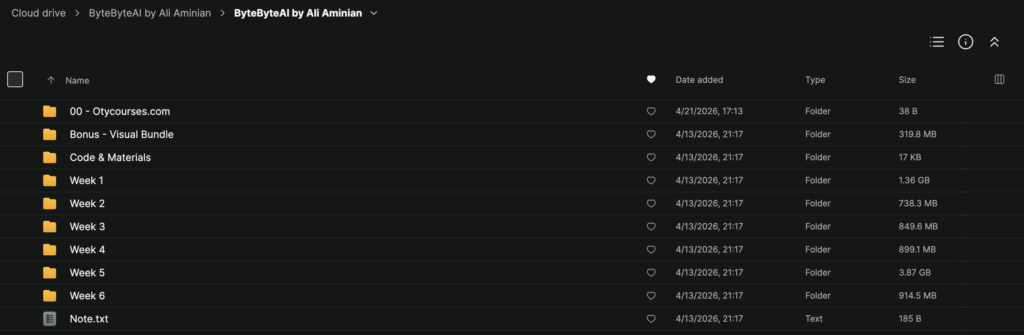
Ali Aminian – ByteByteAI is a hands-on AI engineering program designed to help you move from theory to real-world implementation. Built as a structured, project-based system, this training focuses on teaching you how to design, build, and deploy modern AI applications using practical workflows.
Instead of passive learning, ByteByteAI follows a “learn by doing” approach, guiding you through real projects like chatbots, AI agents, and multi-modal systems. By the end of the course, you’ll have the skills to build scalable AI solutions from scratch and apply them in real-world environments.
What’s Included in ByteByteAI
Inside this program, you get a complete AI engineering system:
- Project-based learning framework
- Step-by-step AI system building process
- LLM (Large Language Model) training and usage
- Retrieval-Augmented Generation (RAG) systems
- AI agents and automation workflows
- Multi-modal AI (image and video generation)
- Real-world deployment strategies
Ali Aminian – ByteByteAI Course Outline (Project-Based Learning)
Project 1
Build an LLM Playground
LLM Overview and Foundations
Pre-Training
- Data collection (manual crawling, Common Crawl)
- Data cleaning (RefinedWeb, Dolma, FineWeb)
- Tokenization (e.g., BPE)
- Architecture (neural networks, Transformers, GPT family, Llama family)
- Text generation (greedy and beam search, top-k, top-p)
Post-Training
- SFT
- RL and RLHF (verifiable tasks, reward models, PPO, etc.)
Evaluation
- Traditional metrics
- Task-specific benchmarks
- Human evaluation and leaderboards
Chatbots’ Overall Design
Project 2
Build a Customer Support Chatbot using RAGs and Prompt Engineering
Overview of Adaptation Techniques
Finetuning
- Parameter-efficient fine-tuning (PEFT)
- Adapters and LoRA
Prompt Engineering
- Few-shot and zero-shot prompting
- Chain-of-thought prompting
- Role-specific and user-context prompting
RAGs Overview
Retrieval
- Document parsing (rule-based, AI-based) and chunking strategies
- Indexing (keyword, full-text, knowledge-based, vector-based, embedding models)
Generation
- Search methods (exact and approximate nearest neighbor)
- Prompt engineering for RAGs
RAFT: Training technique for RAGs
Evaluation (context relevance, faithfulness, answer correctness)
RAGs’ Overall Design
Project 3
Build an “Ask-the-Web” Agent similar to Perplexity with Tool calling
Agents Overview
- Agents vs. agentic systems vs. LLMs
- Agency levels (e.g., workflows, multi-step agents)
Workflows
- Prompt chaining
- Routing
- Parallelization (sectioning, voting)
- Reflection
- Orchestration-worker
Tools
- Tool calling
- Tool formatting
- Tool execution
- MCP
Multi-Step Agents
- Planning autonomy
- ReACT
- Reflexion, ReWOO, etc.
- Tree search for agents
Multi-Agent Systems (challenges, use-cases, A2A protocol)
Evaluation of agents
Project 4
Build “Deep Research” Capability with Web Search and Reasoning Models
Reasoning and Thinking LLMs
- Overview of reasoning models like OpenAI’s “o” family and DeepSeek-R1
Inference-time Techniques
- Inferece-time scaling
- CoT prompting
- Self-consistency
- Sequential revision
- Tree of Thoughts (ToT)
- Search against a verifier
Training-time techniques
- SFT on reasoning data (e.g., STaR)
- Reinforcement learning with a verifier
- Reward modeling (ORM, PRM)
- Self-refinement
- Internalizing search (e.g., Meta-CoT)
Project 5
Build a Multi-modal Generation Agent
Overview of Image and Video Generation
- VAE
- GANs
- Auto-regressive models
- Diffusion models
Text-to-Image (T2I)
- Data preparation
- Diffusion architectures (U-Net, DiT)
- Diffusion training (forward process, backward process)
- Diffusion sampling
- Evaluation (image quality, diversity, image-text alignment, IS, FID, and CLIP score)
Text-to-Video (T2V)
- Latent-diffusion modeling (LDM) and compression networks
- Data preparation (filtering, standardization, video latent caching)
- DiT architecture for videos
- Large-scale training challenges
- T2V’s overall system
Project 6
Capstone Project
- Choose your own idea
- Build with techniques from the course
- Get real-time feedback from the instructor as you build
- Demo + feedback session
ByteByteAI Bonuses!
Bonus 1:
Free access to all ByteByteGo digital books, valued at $500
Bonus 2:
Get Exclusive ML Resources — Constantly Updated!
Bonus 3:
Get Featured in the ByteByteGo Newsletter — Reaching Over 1 Million Subscribers
What You Will Learn
By completing this course, you will learn:
- How to build AI applications from scratch
- How to work with LLMs and prompt engineering
- How to design AI systems for real-world use
- How to create AI agents and automation workflows
- How to deploy scalable AI solutions
- How to combine multiple AI technologies
Who This Course Is For
This course is ideal for:
- Developers and engineers
- Data enthusiasts
- Tech founders and builders
- AI learners who want practical experience
- Anyone looking to move beyond basic AI knowledge
Why ByteByteAI Is Valuable
- Fully project-based learning approach
- Focus on real-world implementation
- Covers modern AI technologies (LLMs, agents, RAG)
- Includes advanced and beginner-friendly content
- Helps bridge the gap between theory and practice
Course Details
- Format: Live sessions + recordings + projects
- Duration: ~6 weeks
- Access: Digital access
- Level: Beginner to Advanced
Meet Ali Aminian
Ali Aminian is a best-selling author known for his work in machine learning and generative AI. With more than a decade of experience at top technology companies, he has developed advanced AI systems focused on intelligence, safety, and efficiency. In addition to his industry work, he contributes to AI education at Stanford University, where he blends deep technical knowledge with a strong passion for teaching.
Final Thoughts
The Ali Aminian – ByteByteAI course is a complete system for anyone serious about becoming an AI engineer and building real applications.
If you want to go beyond basic concepts and start creating powerful AI systems, this course provides a structured and practical path forward.
Get ByteByteAI by Ali Aminian.